

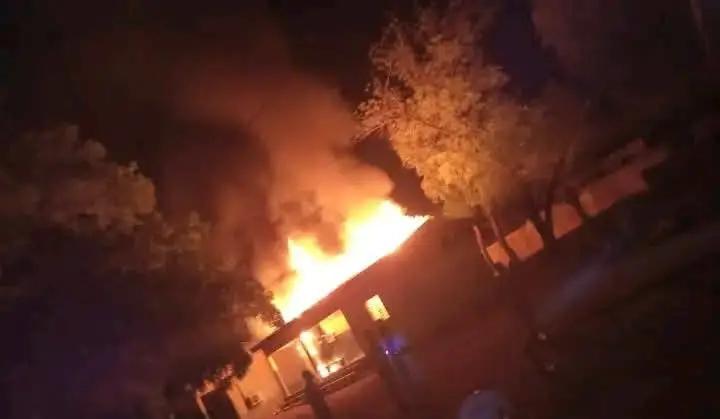
The Ebola response in the Democratic Republic of Congo (DRC) is facing serious obstacles. Tensions have flared in Rwampara, Ituri province, where part of the general hospital was set on fire. The cause? An angry population opposed to the medical teams taking care of the body of a deceased young man, described as a popular local footballer.
Relatives wanted to organize a traditional burial, but health authorities refused, suspecting an Ebola case. This situation escalated into clashes. Demonstrators attacked the hospital with stones before setting fire to tents used as isolation units. Security forces had to intervene, firing warning shots to disperse the crowd, and medical personnel were placed under military protection.
The NGO Alliance for International Medical Action (ALIMA) confirmed the burning of two tents used to treat Ebola patients. Six patients who were being treated there were initially reported missing, but were eventually found and continue to receive care.
Authorities are reminding people that the bodies of Ebola victims are highly contagious and that burials must be supervised by specialized teams. However, deep mistrust persists in some communities in Ituri, where some residents believe that Ebola is a foreign invention. Luc Malembe Malembe, a local political leader, points out that this mistrust considerably complicates response efforts.
The current epidemic, due to the rare Bundibugyo strain, continues to progress in the DRC and Uganda. This strain has no approved vaccine, making the fight more complex. On May 16, 2026, the World Health Organization (WHO) declared the Ebola epidemic caused by the Bundibugyo virus in the DRC and Uganda a public health emergency of international concern.
As of May 20, 2026, there were approximately 600 suspected cases, including 139 deaths. The WHO has sent medical supplies to the DRC and released emergency funds. Authorities are working to set up field hospitals to cope with the influx of patients.
The situation is all the more worrying as armed conflicts and population displacements hinder the response. Access to affected communities is difficult, and misinformation fuels mistrust of health workers. Despite these challenges, medical teams remain mobilized to contain the epidemic and save lives. The priority is to set up adequate treatment centers to ensure case detection and patient care.